Home » Research » Research Symposium » Postgraduate Research Symposium 2021

Impactful Research Through Interdisciplinary Approach

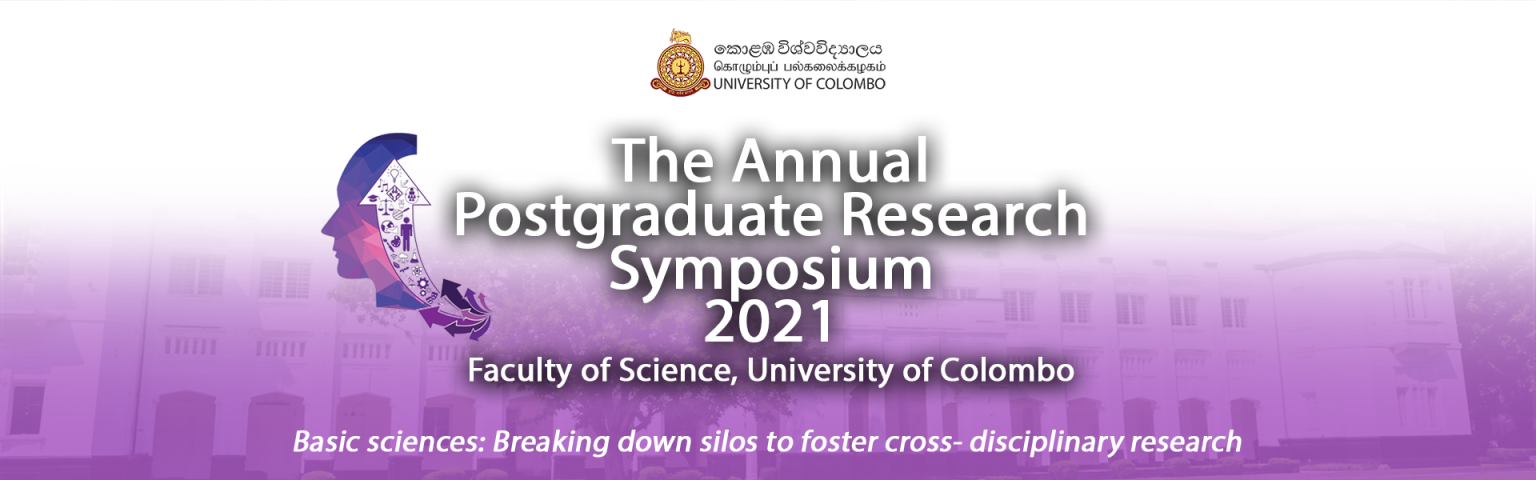
Postgraduate Research Symposium 2021

THEME: Impactful Research Through Interdisciplinary Approach

The Technical Sessions of the Faculty of Science, organized as part of the Annual Research Symposium 2021 of the University of Colombo, was successfully held on 25 th and 26 th November 2021. These sessions were a part of the International Conference on Multidisciplinary Approaches in Science 2021 (ICMAS), held under the theme ‘Basic sciences: Breaking down silos to foster cross- disciplinary research’.

At this session, 37 abstracts were presented by postgraduate students/academic staff of the Faculty of Science. The presentations were held on a virtual platform and drew wide interest from both academic members and postgraduate students.

In keeping with the vision of the Faculty of Science to produce postgraduates that are distinguished by their professionalism, committed to ongoing learning and personal development, confident and adaptable and able to aptly communicate and blend into the wider contexts in which they work, we strive to equip them to be competitive, effective and productive.

As a faculty that focuses heavily on research and innovation, we encourage research dissemination and take initiatives to show case and reward research efforts. The technical sessions of the faculty of science in 2021 focusing on “Research applications of national importance’ was held on the 24th of November 2021 from 1 p.m. onwards. This was conducted as part of the ICMAS sessions.

The presented talks were different from those presented before, in that it targeted a wider audience from educational entities, from industries and also the general public as the presented findings were important in terms of national development.

An interactive discussion was facilitated by an eminent panel of experts including Dr. Ruchira Wijesena a Senior Scientist at the Sri Lanka Institute of Nanotechnology (SLINTEC); Dr GAS Premakumara who is the Head of the Dept. of Basic Sciences & Social Science, Faculty of Nursing, University of Colombo; Dr. Chithraka Wickramarachchi a Senior Lecturer in the Department of Statistics, University of Sri Jayewardenepura; Prof. I.G.N. Hewajulige, Additional Director and Research Professor, Research and Development Division at the Industrial Technology Institute (ITI) of Sri Lanka.

A total of 16 interesting talks were presented at these sessions.

  • Development of advanced filter materials for water purification
  • Development of Kajjali loaded electro spun fibre mats for wound care
  • Smart nanofibrous textiles for skin care applications: A solution for cancer and aging
  • Conserving our neritic tuna resources for future generations
  • Ensuring human health and food security through novel cereal and fruit-based probiotics
  • Molecular discovery: Bioactive cyclotides and secondary metabolites from Sri Lankan medicinal plants
  • In-silico study on effectiveness of antidiabetic properties of active compounds of bitter gourd and enhancing these properties through processing methods
  • Bioactive properties of finger millet varieties cultivated in Sri Lanka
  • Novel herbal formulations for rejuvenation and weight loss
  • Development of recombinant bacterial strains for effluent metal bioremediation
  • Microbe-assisted value addition to Eppawala Rock Phosphate: A possible replacement to TSP
  • Achieving the country’s rice production with 50% less urea – through a microbial biofertilizer
  • A dynamic model for Load Forecasting: Two level Neuro-Functional Load Forecaster
  • A study of employment among Arts Graduates in Sri Lanka
  • Risk Assessment Model for deliberate introduction of Invasive Alien Plant species in Sri Lanka
  • Mathematical modeling of Dengue Virus dynamics

The synopsis of these talks were published in the ICMAS proceedings.

The highlights of the inauguration included the keynote speech delivered by Prof. Saman Senaweera, Honorary Professor, University of Melbourne, Australia, on the topic “Biofortification of Cereals: Unlocking the Genetic Pathways to Achieve Global Zinc Malnutrition.” This was followed by two invited presentations delivered by young academics of the faculty: Dr. Kalpani Marasinghe (“Multidisciplinary Marine Science for Human Resilience: From Ecosystem Understanding to Innovation and Sustainable Utilization”) and Dr. Muditha Bandara (“Individual MRI for Human-Centric Personalized Medicine”).

In the latter sessions of the technical program, 31 postgraduate students and academics of the faculty presented their research under four tracks: (1) Physics (2) Mathematics, Statistics and Nuclear Science (3) Chemistry and (4) Biological Science. Each track was enriched by a guest speaker who delivered valuable presentations covering diverse subject areas.

Keynote Speakers
Seminar Talk
Human Capital, Employment and Economic Empowerment
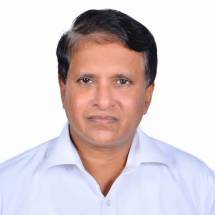
Dr. Harsha Aturupane Lead Economist The World Bank
Professor Mohan Munasinghe
Dr. Harsha Aturupane is a Lead Economist in the World Bank. He has worked and written extensively in the fields of human development, education economics, higher education, general education, labor economics, welfare economics, and poverty reduction. He has led teams in the preparation and supervision of World Bank projects and programs covering higher education, general education, health, social protection, economic reform, and strengthening governance processes. His work experience covers the East Asia, South Asia, Europe and Central Asia, Middle East and North Africa, East Africa, and West Africa regions of the World Bank. He has a Ph.D. and M.Phil. in Economics from the University of Cambridge and a B.A. in Economics and Diploma in Economic Development from the University of Colombo.
ABSTRACT:

The global economy is now experiencing the Fourth Industrial Revolution. The first Industrial Revolution, from about 1760 onwards, was based on mechanical production and saw such revolutionary innovations as steam powered industrial production and railway-based transport. The second Industrial Revolution, from around the 1860 onwards, saw the widespread application of electricity, and the use of the assembly line and mass production in industry. The third Industrial Revolution, from about the 1960 onwards, saw increasingly automated production, and the widespread use of electronics and computers. The fourth industrial revolution is based on developments such as artificial intelligence, big date, robotics, biotechnologies and neuro-technologies. Just as the nature of economic production and jobs were transformed by the technological advances of the first, second and third Industrial Revolutions, the scope and content of economic production and jobs will be transformed by the fourth Industrial Revolution.

Revolutionary changes in technology have a three-fold impact on jobs. First, some jobs are lost as machines replace human beings. For instance, equipment such as tractors now perform many agricultural tasks that previously required manual labor in agriculture. Second, many jobs continue but need new skills for their full execution. As an example, university academics today routinely use computers and software relevant for their academic disciplines. Earlier generations of academics used pen and paper, and blackboards, for the same tasks. The productivity of jobs increases with the application of technology. Third, new jobs are created. Many jobs linked with modern internet-based services did not exist until late in the computer era. Among these, the transformation of jobs require new skills is usually the most common feature of economies. This is followed by the creation new jobs and then the loss of certain old jobs with obsolete skills.

Human capital production and accumulation needs to be continuously transformed to meet the changes in skill needs. The demand for advanced cognitive and socio-emotional skills is increasing, while that for less advanced skills that can be readily automated is decreasing. This requires adaptation in curricula, teaching and learning, and assessment, across education systems. Further, disruptive change is predicted to transform the skills needed in future careers multiple times. Education and training systems need to support children, youth and adults to make these changes.

Technological development is skills based and thus investing more in human capital has higher returns, and now more than ever before in history. From about the mid-1980s the rates of return to higher education have been rising. This process has accelerated with the advent of the fourth industrial revolution. Investment in human capital is a necessity for productive engagement with the global knowlage economy.

Traditional education systems are increasingly struggling to produce the new skills needed. The focus of education systems has been mainly on intelligence or initial cognitive ability and cognitive skills. However, these are not adequate in the era of the fourth industrial revolution. The focus of education systems needs to be broadened beyond intelligence as an education input and beyond cognitive skills as an education outcome. Fortunately, research and policy are advancing in these areas.

Personality traits determine academic performance and skill formation. The big five personality traits: openness to experience, conscientiousness or perseverance, extraversion. agreeableness, and emotional stability, matter for success in school, university and in the labor market. For instance, research shows that conscientiousness matters as much as intelligence for employment outcomes. Further, openness to experience is very important for innovation.

Socio-emotional skills are analogous to personality traits, but with emphasis on malleability. These skills are important determinant of economic outcomes. They have an indirect effect, through cognitive skills, on job performance. They also have a direct effect on earnings, for example through openness and conscientiousness. Both cognitive and socio emotional skills contribute to productivity. What you know matters for creativity and cognitive skills are important. but socio-emotional skills too as shown in repeated labor market studies.

The education system can promote socio-emotional skills. There are several key dimensions of a high performing education system. First, good quality early children education is vital. The foundations of personality and learning are laid in the early years. Second, school systems need to be transformed to promote both cognitive learning and socio-emotional skills. This requires frsh approaches to curricula, teaching-learning, and assessment. Third, it is important to have well-timed and effective vocational training and technical education. Fourth, a high quality and widely accessible higher education system is needed. Fifthly and finally, these elements of education need to construct an efficient and productive life-long learning system.

Economic policies can promote the creative use of all forms of human capital. A pro market economic environment is needed as it produces a variety and diversity of opportunities. A market-friendly environment also creates space and freedom and rewards for innovation. Policies that stifle markets, conversely, hamper the productive use of skills. A vital component of a pro-market economic environment is openness to international trade, with free cross border flows of goods and ideas. This, in turn, provides exposure to new thinking and the creation of new opportunities.

The broader ethical framework of society needs to be favorable to innovation and development.Democracy is of central importance for economic prosperity. Democracy promotes innovation while authoritarianism suffocates innovation. Also, ethical teams are more productive than unethical groups. The social capital provided by shared values, norms and codes of good conduct are necessary to underpin a well-functioning economy based on productive and innovative human capital.